Photoreactor Farm Tower
Algae Landscape Design Example: Photoreactor Farm Tower
Designed for the Land Art Generator Initiative (LAGI) by Gregoire Diehl, Smoothcore Architects. The goal of LAGI was to design and construct public art installations that have the added benefit of large scale clean energy generation. Each sculpture would continuously distribute clean energy into the electrical grid, having the potential to provide power to thousands of homes. The 2010 LAGI design competition was held for three sites in the United Arab Emirates and received hundreds of submissions from over 40 countries.
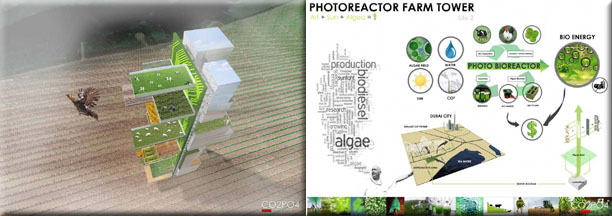
Artist’s descriptive text: Photoreactor Farm Tower is an active landart piece which takes Dubai’s underused context elements to start the new energy revolution and produce alternative fuel. The context elements are Sea (used as an algae tank), Desert (used as an infinite algae field) and Sunlight (used to grow algae).
Photoreactor Farm Tower (PFT) is an active artifact. The algae fields are an artistic installation made of illuminated vertical green glass tubes with algae in them. By going vertical, you can get a lot more surface area to expose cells to the sunlight. It keeps the algae hanging in the sunlight just long enough to pick up the solar energy they need to produce, to go through photosynthesis.
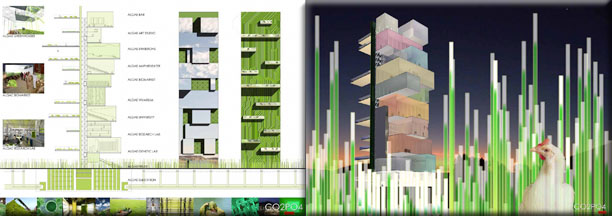
The PFT team (architects, artists, researchers, landscape architects) believes algae can someday be competitive as a source for biofuel. The plant is a giant solar collecting system getting energy from sunshine. Algae are among the fastest growing plants in the world, and about 50 percent of their weight is oil. That lipid oil can be used to make biodiesel for cars, trucks, and airplanes. Instead of ponds, the PFT uses a closed, vertical system, growing the algae in long glass illuminated tubes, and can produce about 100,000 gallons of algae biofuel a year per acre, or the equivalent of 2,500 MWh of electricity.
Source: LandArtGenerator.org.
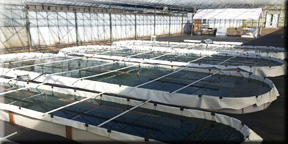 SF Bay Area Spirulina Microfarm